

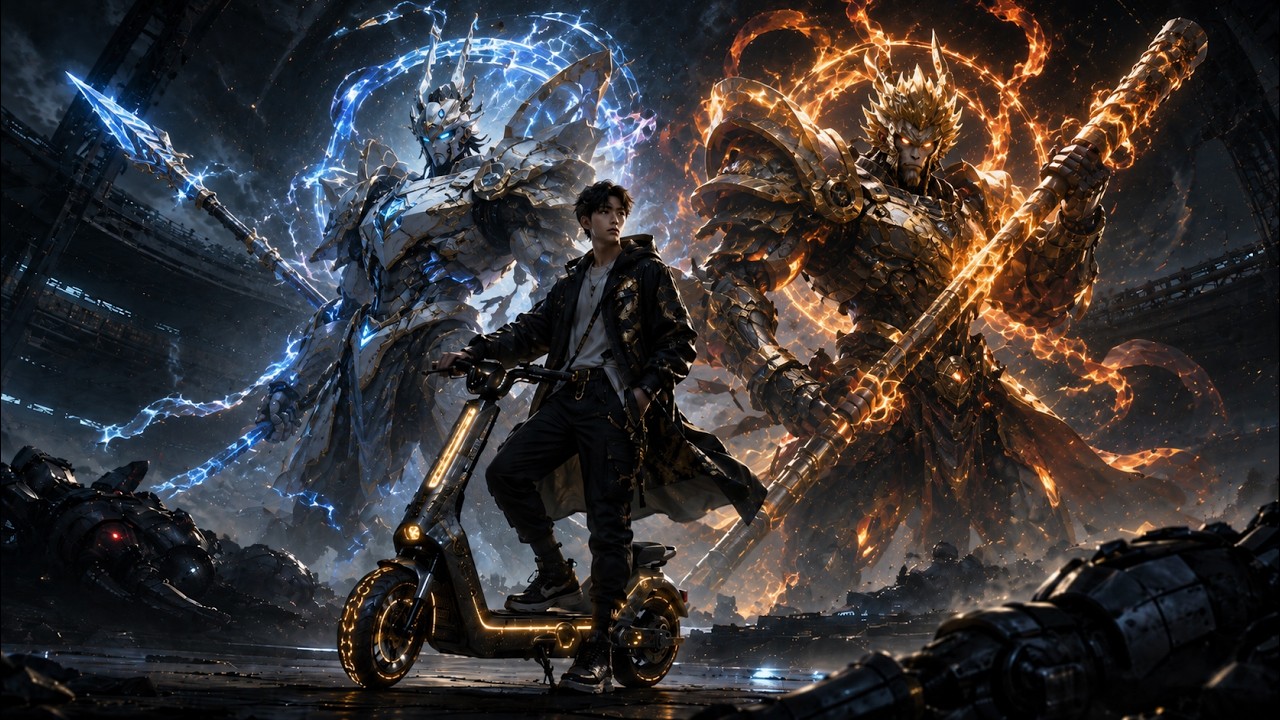
Mech Myth: I Awakened the Ancient Chinese Gods
An Epic Sci-Fi Saga of Mythological Mechas, Underdog Reversal, and Interstellar Destiny
1. Synopsis: The Last Hope of Yan Huang City
Language Note: This micro-drama features Indonesian audio, with YouTube's auto-generated caption options available for international accessibility.
Set in the year 8224, humanity survives in domed cities after a cosmic metal storm transforms Earth's creatures into bloodthirsty mechanical beasts. Yan Huang City faces expulsion from the core zone after losing eight consecutive mecha battles. Lin An, an outcast who secretly holds the fragmented memories of ancient Chinese myths, steps up as the last hope. Resonating with the mystical "Ling Shu" core, he transforms a humble electric scooter into a god-tier mecha, summoning legendary figures like Nezha (the Third Prince) and Erlang Shen. Facing betrayal, arrogant rival cities, and a megalomaniacal commander attempting to absorb all hero personalities to become a mechanical god, Lin An fights to protect his home. In a climactic battle, he sacrifices himself to seal a chaotic void rift, only to miraculously return and lead humanity in building an interstellar warship to explore the stars and eradicate the mechanical threat once and for all.
2. Cinematic Review: 7.2/10
Mech Myth: I Awakened the Ancient Chinese Gods delivers a highly ambitious, visually striking blend of post-apocalyptic sci-fi and classical mythology, though it transparently exposes the current technical boundaries of AI in rendering complex mechanical transformations and large-scale energy effects.
- Narrative & Thematic Execution (8/10): The script masterfully executes the "underdog reversal" trope, scaling the stakes from a local arena battle to a cosmic, interstellar conflict. The integration of Chinese mythological figures (Nezha, Erlang Shen, Sun Wukong) into mecha forms is a highly creative and engaging narrative hook.
- Visual Fidelity & Transparent Limitations (6.5/10): The conceptual art of the mythological mechas and the dystopian domed cities is visually impressive. However, to be completely transparent: generative video models inherently struggle with complex, multi-limb mechanical structures and rapid transformations. There is noticeable temporal flickering and "morphing" artifacts during Nezha's "three heads and six arms" transformation and the final cosmic void sequences, where structural coherence occasionally breaks down.
- Audio & Lip-Sync Execution (7/10): The sound design (roaring mecha engines, clashing steel, epic orchestral swells) is highly immersive. However, extended dialogue scenes reveal the limitations of automated dubbing or lip-syncing; mouth movements frequently feel detached or desynchronized from the emotional delivery of the voice tracks, a common artifact in heavily post-processed micro-dramas.
3. Technical Autopsy
Producing a long-form sci-fi/mecha micro-drama with complex transformations requires a highly specialized, multi-layered generative and compositing pipeline. Based on the visual artifacts, here is a precise technical autopsy of the workflow:
- Concept Art & Asset Generation (Midjourney v6): The foundational frames for the mythological mecha designs, dystopian cityscapes, and cosmic void environments were likely generated using Midjourney v6 with
--style rawand--cinematicparameters. Character referencing (--cref) was utilized to maintain pilot consistency, though some drift is inevitable in wide, chaotic battle shots. - Video Motion & Physics (Runway Gen-3 Alpha / Kling AI): The mecha transformation sequences, energy blasts, and dynamic combat indicate the use of advanced video models like Runway Gen-3 Alpha or Kling AI. While excellent at controlled motion, these models exhibit known limitations in maintaining strict structural coherence for complex, multi-jointed mechanical forms during rapid action, resulting in the aforementioned morphing artifacts.
- Lip-Sync & Facial Animation (Hedra / LivePortrait): For dialogue-heavy scenes in the arena or command centers, static or semi-rigged character frames were likely processed through specialized lip-sync tools like Hedra or LivePortrait to map the audio to facial movements, explaining the occasional mechanical or "floaty" mouth mechanics.
- Voice & Post-Production (ElevenLabs / Localized Cloning + Topaz Video AI): The dramatic, high-stakes voice acting suggests the use of advanced voice cloning tools tuned for sci-fi drama. Finally, the raw outputs were likely passed through Topaz Video AI for upscaling and frame interpolation, smoothing out the inherent choppiness before final color grading and sound mixing in DaVinci Resolve.
“ Creator Spotlight:
This ambitious sci-fi/mecha micro-drama was produced by Saga AI Cerita. To support their groundbreaking work in blending classical mythology with futuristic AI-generated storytelling, please visit and subscribe to their Official YouTube Channel. ”



0 Comments