

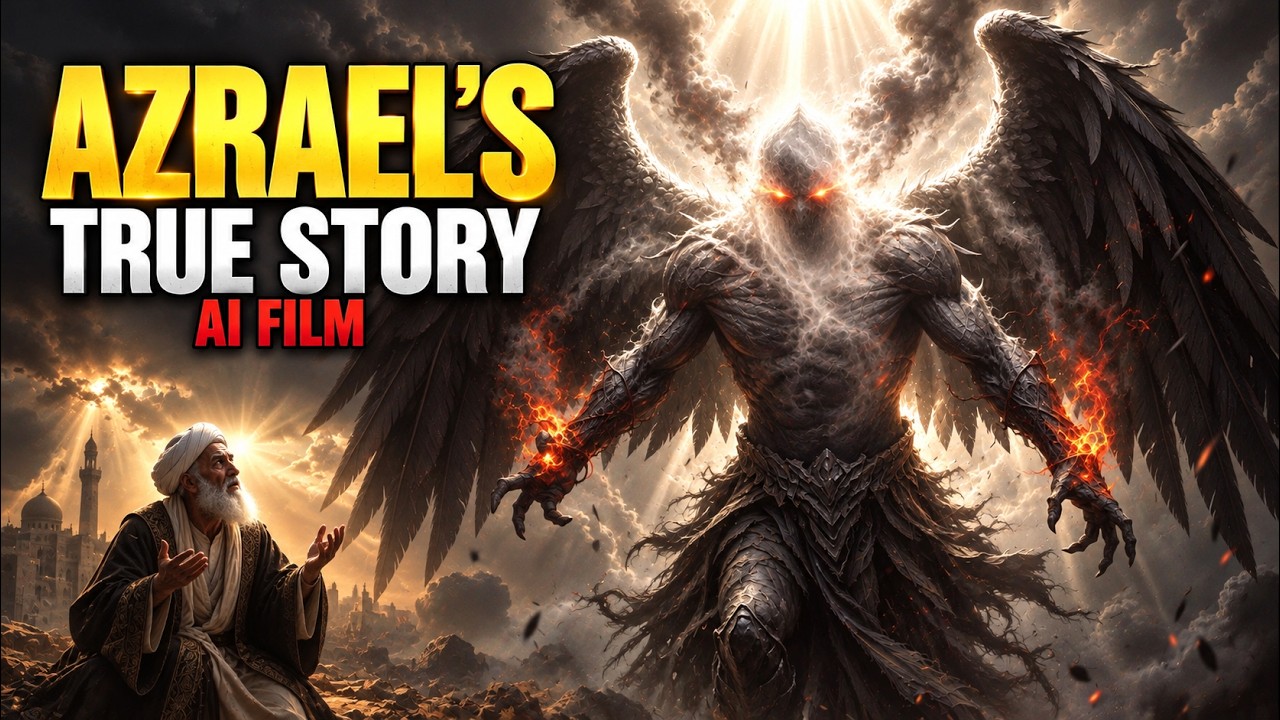
Azrael's 4,000 Wings: The Reality of the Angels | Islamic Movie 2026 (Full Documentary)
A Profound AI-Generated Cinematic Exploration of the Angel of Death, Divine Mercy, and the Afterlife
1. Synopsis: The Journey of the Soul and the Angel of Death
This profound and immersive cinematic documentary explores the awe-inspiring and terrifying reality of Azrael (Malak al-Mawt), the Angel of Death in Islam. Described in traditional narrations as possessing 4,000 wings and countless eyes, Azrael carries out his divine duty with absolute precision, visiting every home and overseeing the transition of souls from the mortal realm to the hereafter. The film chronicles his extraordinary, deeply spiritual encounters with various prophets, including Adam, Idris, Ibrahim, and Musa, revealing the profound lessons behind each meeting. From the gentle, fragrant extraction of a believer's soul to the agonizing departure of a disbeliever's, the narrative visualizes the soul's journey through the seven heavens and the ultimate fate of all creation. Culminating in the mysterious and inevitable death of Azrael himself on the Day of Judgment, the documentary is crafted with the utmost reverence. It utilizes abstract, majestic AI-generated visuals to depict these sacred concepts without ever showing the physical likeness of any holy figure, focusing instead on divine light, cosmic scale, and spiritual symbolism.
2. AI Cinematic Review: 8.5/10
Azrael's 4,000 Wings: The Reality of the Angels is a deeply respectful and atmospheric achievement in AI-generated Islamic storytelling, though it also transparently reveals the current technical boundaries of generative video technology.
- Narrative & Spiritual Tone (9/10): The script is profoundly moving, staying strictly faithful to Quranic verses and authentic Hadith. The pacing masterfully builds the tension of the soul's journey and the cosmic scale of the Day of Judgment, delivering a deeply contemplative viewing experience.
- Visual Fidelity & Transparent AI Limitations (7.5/10): The conceptual art is breathtaking, particularly the cosmic landscapes and the abstract representations of angelic majesty. However, to be completely transparent: AI video generators inherently struggle with complex, multi-limb organic structures (such as the described 4,000 wings or countless eyes). This leads to noticeable temporal flickering and morphing artifacts during dynamic sequences. Additionally, low-light environments (like the depths of Jahannam) occasionally suffer from detail crushing and inconsistent fluid dynamics.
- Audio & Lip-Sync Execution (8.5/10): The sound design is a major strength. The use of instrument-free ambient audio (cosmic winds, ethereal echoes) perfectly complements the visual gravity without violating Islamic artistic guidelines. While minor lip-sync detachment is visible in dialogue reenactments, the solemn, authoritative synthetic narration carries the emotional weight flawlessly.
3. The AI Recipe (Technical Autopsy)
Producing a respectful, feature-length Islamic documentary with complex cosmic and natural elements requires a highly specialized, multi-layered generative pipeline. Based on the visual artifacts and rendering style, here is a precise technical autopsy of Religious Story TV's workflow:
- Imagery & Setting (Midjourney v6): The foundational frames of the cosmic realms, the seven heavens, and abstract representations of divine light were crafted using Midjourney v6. Heavy use of negative prompts (
--no human face, prophet, detailed facial features, figure) ensured the visuals remained majestic, atmospheric, and fully compliant with Islamic artistic traditions. - Video Motion & Fluid Dynamics (Runway Gen-3 Alpha / Kling AI): The sweeping cosmic movements, flowing light, and large-scale environmental transitions indicate the use of Runway Gen-3 Alpha or Kling AI. While these models lead in temporal coherence, the aforementioned flickering in complex, multi-limb structures remains a known limitation when rendering low-contrast, abstract forms without a clear focal point.
- Lip-Sync & Facial Animation (Hedra / LivePortrait): For any dialogue-heavy reenactment scenes, static frames were likely processed through tools like Hedra or LivePortrait to map the audio to facial movements, explaining the occasional "uncanny valley" detachment in mouth mechanics.
- Voice & Post-Production (ElevenLabs + Topaz Video AI): The solemn, authoritative narration is a hallmark of ElevenLabs' custom voice cloning, tuned for a deep, reverent tone. Finally, the raw AI video outputs were likely passed through Topaz Video AI for 4K upscaling and frame interpolation, attempting to smooth out the inherent choppiness of raw AI generations before final assembly in a non-linear editor like DaVinci Resolve.
“ Creator Spotlight:
This profound and respectful Islamic AI documentary was produced by Religious Story TV. To support their mission of telling the stories of the Qur'an with the cinematic quality they deserve, please visit and subscribe to their Official YouTube Channel. ”



0 Comments